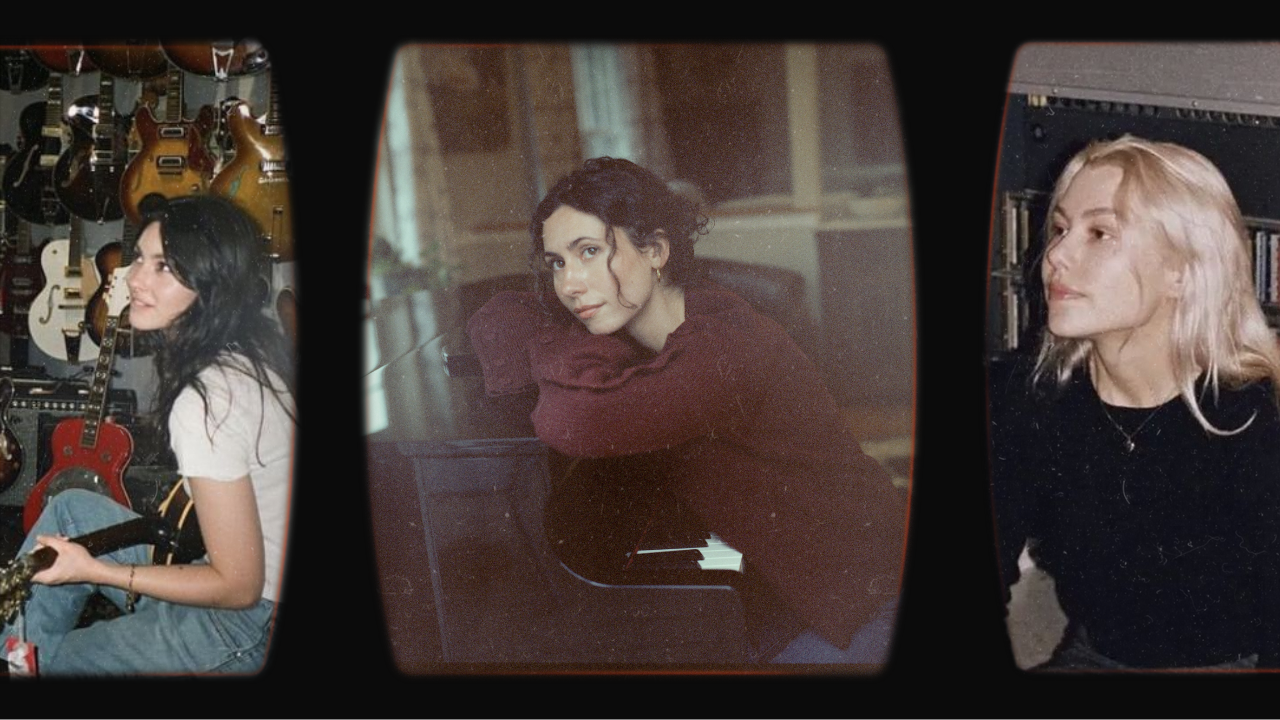
These past couple of weeks have included some of the best music drops and announcements, and I think that today’s releases are just the first accumulation of the exciting place that music is in this year. From the grand return of Phoebe Bridgers to the exciting first EP from Jackie Evans, this week’s new music hints at a renaissance for the pop and pop-adjacent genres that is separate from the synthy, country takeover that is plaguing more and more releases. Here are some brief reviews for several of the releases from today (and one from yesterday) that came across my desk this morning; I am sure they are not representative of every person who dropped music today, but they are definitely representative of the music that I listen to on a regular basis.
My theme for the selection of songs that I chose to review in this post is taking a chance. I have listened to a big return, a brand-new start, and some second singles, but they all require someone taking a chance. In some cases it’s the artist, in others it’s the listener; for one of these songs, it’s a second chance for someone in my life. These four songs all have interesting aspects, and hopefully you give me the chance to recommend (or not) them to you!
“Lost Boys” – Phoebe Bridgers
This was a comeback 3-6 years in the making, depending on how much the Boygenius album tied you over for a Pheebz release. “Lost Boys” is the lead single off of Bridgers’ upcoming third solo album, Lost Weekend, a much-anticipated project preceded by a series of pop-up shows and the long-awaited album announcement on June 25th. The song itself is Phoebe Bridgers at its core: a guitar-driven tune with a production style that makes you feel like you’re drowning and emotional lyrics that take more than a couple listens to fully grasp. With that said, this song definitely shows an evolution in Bridgers’ sound. She leans into a harsher and more intense sound than found on her previous solo work, which is defined by more wistful instrumentals and auxiliary noises that provoke similarities to siren songs. “Lost Boys” is definitively more present, making you feel less like you’ve been abruptly pounded by a wave and more like you’ve purposely dived into the water. If you were to compare this lead single to anything else in her catalog, I would point to her album with Conor Oberst, Better Oblivion Community Center; they are both instrument-focused with a true indie/folk rock feel. I do find it interesting that she chose to lead with an upbeat track for this album since she has not exactly come to be known for fun and high-energy songs; I cannot say that I’m surprised, as the few upbeat songs in her solo discography tend to garner the most popularity from the general public (I’m thinking about “Motion Sickness” and “Kyoto” in particular).
In the upbeatness of this song and its repetitive melody and chorus, I was immediately reminded of The 1975. Again, not surprising, as Bridgers has collaborated with them in the past and has been part of a few of their projects in the years since the release of Punisher, but it is interesting because Jack Antonoff is credited as both a producer and performer on this track. Antonoff produced the last album from The 1975, and it is their cleanest and most cohesive project to date. As a loyal fan of Antonoff’s, this is very exciting for me, and to those that believe he needs to produce less people’s music, I have faith this album will prove you wrong. Antonoff is not the only interesting collaborator on this track; we see some of her typical collaborators like Christian Lee Hutson and Marshall Vore, the return of fellow indie rock supergroup members Julien Baker and Lucy Dacus, putting to bed any rumors of a falling out, and some surprise appearances from Alex G in performance and songwriting and Bo Burnham, credited as a songwriter. These are just some from a whole list of artists that worked on this track alone, proving Bridgers’ abilities beyond devastating writing and haunting vocals, pushing her into curator territory as well.
This lead single is a promising first taste of this third album, as if the packed pop-up shows weren’t enough. As a long-term Pharb who would put on “Garden Song” first thing in the morning before hopping on virtual school, you can imagine how excited I am to get more solo music, but also as a more critical music lover, I believe this album will make Phoebe Bridgers a household name akin to Fiona Apple or Alanis Morissette, and I look forward to that too.
“Look at My Life” – Gracie Abrams
To preface, I would not consider myself a Gracie Abrams fan. There are a few songs (the most popular ones) that I enjoy and have on my playlists, but every time I’ve attempted to listen through any of her albums, there is too much bloat, and I can never bring myself to finish them. Despite these not-so-kind words, I do really like her most recent release. “Look at My Life” is the second single off her upcoming album Daughter from Hell; the lead single, “Hit the Wall,” received more praises than previous releases, but I was unable to get into that song despite the good reviews. What is different about “Look at My Life” in comparison to “Hit the Wall” is that it fully brings back the Audrey Hobart cadence that characterizes Abrams’ biggest hits.
A brief bit of history: Hobart was a songwriter on Abrams’ last album, The Secret of Us, that contains Abrams’ biggest hits. Of these smash-hit songs, “That’s So True” and “I Love You, I’m Sorry,” people particularly gravitated towards the rambling melodies that gushed feelings with few breaks to stop and process the situations that Abrams was singing about, mimicking a stream of inner monologue. For a year or so, this niche was the feature that defined Abrams’ sound, and then Hobart released her own music. What was the thing that made Abrams’ hits stand out was now revealed to be a Hobart tick all along: her debut album Who’s the Clown? is littered with these rambles, proving several hits for Hobart, and what once was the Gracie Abrams thing is now the Audrey Hobart thing.
Hobart is not credited on “Look at My Life” at all, so how does this history relate? There is definitely a lot of good on Abrams’ release this week, but the rambling style of the chorus, very similar to her most popular songs, is what makes this song exciting, and now that Hobart is somewhat of a star in her own right, it raises the question of what Abrams brings to the table herself. Her lyrics are interesting and add to the diaristic female songwriter canon, but they are not nearly as emotionally appealing as other artists in her genre like Olivia Rodrigo or Taylor Swift. The song drives to the end, making the listener want to listen through to the climax, but that drive is built through repetitive eighth-note synths, a staple of now go-to pop girl producer Aaron Dessner. Beyond songwriting and production, Abrams is only left credited for the performance vocals and piano, and as her voice is constantly being debated as good or not, it’s hard to say that performing is her best contribution. I want it to be clear: I will be putting this song on a playlist and listening to it, but I do think that what is best in “Look at My Life” can be found in other tracks by other artists, and they will be done better. Until Abrams is able to provide something that cannot be done by anyone else or she starts doing something better than everyone else, her projects will continue to be the filler in people’s playlists as they wait for the better things to come along.
Most of the Time EP – Jackie Evans
Most of the Time is Jackie Evans’ debut collection of songs with nine tracks, two of which are versions of songs found earlier on the EP with Vulfmon. To provide my thoughts on this EP in limited words, it is a strong debut, and I love it. Evans lies at the crossroads between Carole King and Billy Joel as a songwriter with a sound that can be described as a combination of singer-songwriter, pop, and Berklee funk. These characteristics culminate in a clean EP of mainly vocal and piano tunes that allow the listener to sit in Evans’ bittersweet voice and stories. I wish I could say I discovered her completely on my own, but I do need to give credit, as a friend who is only a few connections away from her introduced me to her music just about a month ago.
Prior to the release of the EP, the majority of the songs were released as singles, leaving only two surprises left for release day, so for the most part I have had the chance to really sit with this project. In that time, I have repeatedly returned to her music with its catchy hooks, and for the more melancholic songs, I have returned just to hear her beautiful voice sing on interesting topics. With this familiarity in mind, this EP is establishing what Evans is best at: narrative songs with full piano parts. Most of her songs follow a pattern of sharing something more mundane in the first verse, revealing the theme of that moment (and the song) in the chorus, and continuing to provide examples of that theme that progressively get deeper. She does this best on two songs with contrasting vibes. On the breakup song “Leave You,” she sings of a cocky partner that all of her friends have told her to break up with, culminating in the final chorus in which her parents gave the same advice a year before she finally ended it. This song most prominently features a Billy Joel-esque piano part, but it is paired with barren verses of bass and drums, really allowing the narrative to breathe, building to a strong finish where all the instrumental parts come together. This song is humorous and exciting, and the recorded version on the EP best establishes the studio sound of her upbeat songs. For the song that best establishes the studio sound of her ballads, I point to “Phone Calls,” my favorite song on the EP. The track recounts several phone calls that happened in the middle of the night at different points in her life; her dreamlike vocals carry the song from the simplistic first verse of just piano to the bridge filled with drums, strings, and guitar. Both “Leave You” and “Phone Calls” do exactly what this EP needed to do: establish a studio sound and show what Evans will perfect over the rest of her time releasing music.
I also had the pleasure of seeing Evans perform the entirety of her EP yesterday, June 25th, before its release at midnight. She had a pop-up concert at the PAC in downtown Manhattan, a performance that she said she was treating like an unofficial release party. When you listen through her EP, you will most likely think to yourself, “She must sound amazing live,” and she does. It is almost uncanny how perfect her live vocal and piano skills are; since I had been listening to the singles prior to the EP release, I was really stunned by her ability to give vocals that sounded better than their studio counterparts. Her songs are definitely meant to be heard live, and she acknowledges that, but some of them really come to life with her stage performance. One of the unreleased tracks until today, “10 Till the Morning,” was absolutely stunning live. When paired with her introduction for the song about her time playing in a dueling piano bar, I actually was on the verge of tears listening to the performance. Similarly, the comedy of “Leave You” comes through strong on stage, and the reveal of the parents not liking the partner in the story brings out many laughs from the audience. I hope to see Evans again, maybe when she has a bigger following and is more sure of herself, and in the meantime, I will continue to look forward to her future releases.
“Feels Like Yesterday” – Haden Gold & Miranda Wilcox
If you are shocked one of the names from that heading is in a snakey blog post, I do not blame you. For those that don’t know, I know Haden Gold pretty well, and up until recently, we were not speaking. It is most definitely a story for another day, but he made me aware very quickly once we started speaking again that he would be releasing music, and as someone who can speak to his musical evolution, I thought I would put my thoughts out into the world (mainly because he’s already heard most of them).
“Feels Like Yesterday” is the second single off of the upcoming collaborative album between Gold and Miranda Wilcox, Breakup Season. This album does have a lead single by the same name as the title, but unfortunately its release just missed the return of the blog. “Feels Like Yesterday” is an atypical ballad of raw guitar, confessional lyricism, and several flute moments, all of which conjure allusions to “Norwegian Wood” by the Beatles. I have had the honor of hearing the progression of this track, starting when the lyrics were unfinished to the continuously revised versions played over a car’s sound system. What Gold and Wilcox accomplish in this final version is a folk-esque tune that appeals to both the lyrics people and the music people. The melody subverts the typical emotional ballad by refusing to be easy or sweet but is still beautifully sung by Wilcox, both when it’s singularly her voice and when it’s her voice layered a million times. Diehard music people can probably have conversations about how the auxiliary percussion partnered with the flute sounds like extra resonant bells. If you’re particularly attuned to theory, you can even analyze the ever-so sinister chord progression of the verses and the bridge-type section in contrast to the relief that comes in the refrain. These are all aspects that appeal to the music people that Gold and Wilcox have probably (most definitely) encountered being music students, but for the rest of us who are not so familiar with the theory and like music because it makes us feel something, the lyrics cover that territory. The imagery of wanting to say “I love you” burning holes through tongues, being devastated by someone but keeping them as your wallpaper, and refusing to wash laundry because it will remove someone’s scent from your clothes—the lyrics provoke a truly upsetting image of someone who is heartbroken, yet the key lyric is the one thing you can’t say when you’re going through a breakup: “I love you.”
Everything about this song lends itself to its message. Whether you are a lyrics guy or a music guy, you can hear that this is the confession of a truly ruined person. This song works so well, though, because the intricate instrumental with the vocal singing the lyrics is so well-balanced. Haden once asked me what I think a producer does, and I would still only be able to give a vague answer, but after hearing like four mixes of this song in particular, I know that the producer can make or break a track, and Nate Wilson definitely makes this one. I look forward to hearing the final version of Gold and Wilcox’s album whenever it comes out, and until then, I will be listening to this song in both frustration and pride that it’s good.