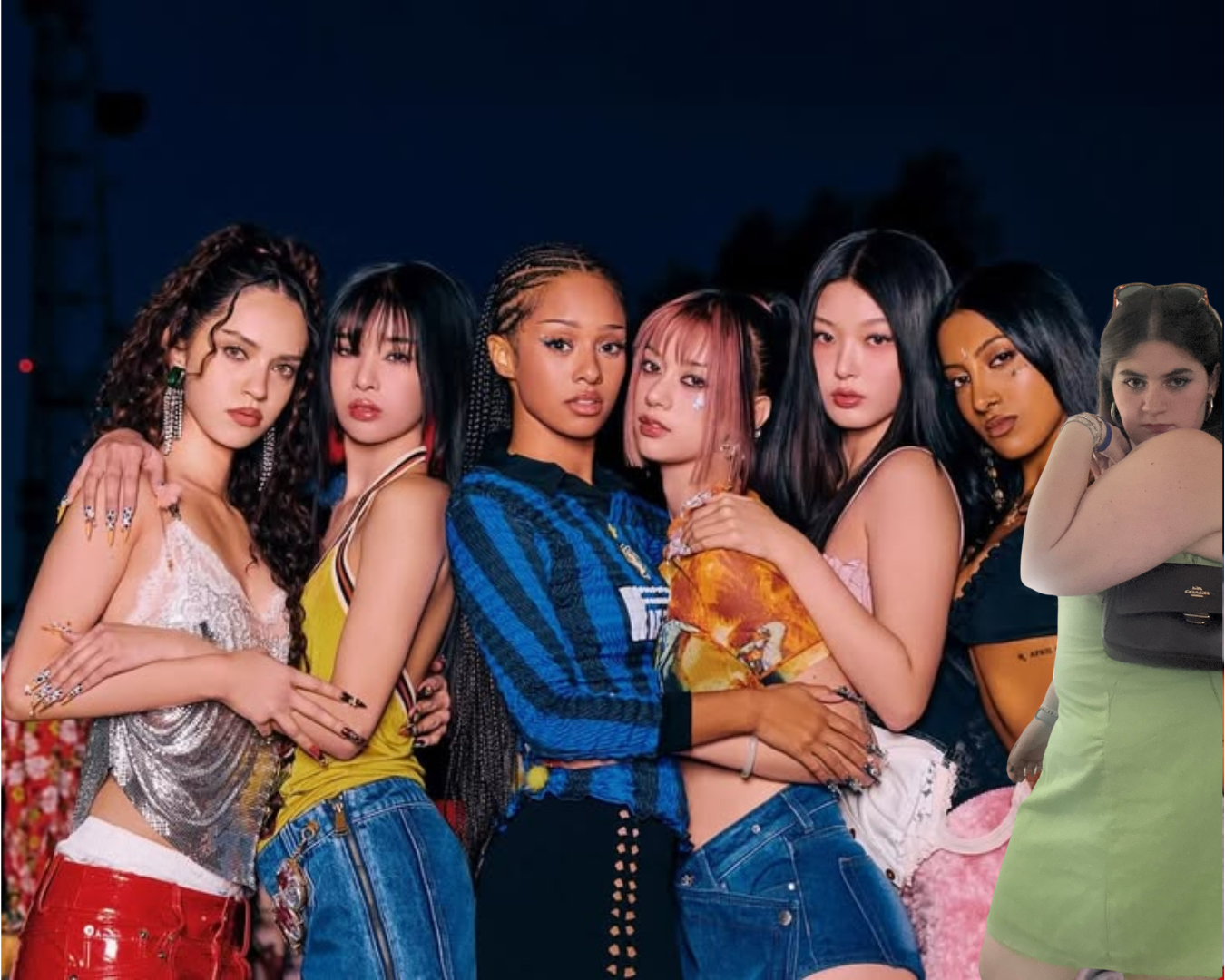
I am not a K-pop fan in the slightest. This is no shade to those who are; I just was never able to get into it. On two occasions I performed K-pop dances with friends for the high school drama club showcase, but those two numbers—”Ditto” and “Super Shy,” both by NewJeans—were the extent of my K-pop knowledge. Despite this, I fell down a rabbit hole this past week, not necessarily regarding K-pop as a whole, but about KATSEYE, Pop Star/Dream Academy, and the translation of the K-pop process to a Western market.
For those that don’t know, K-pop label HYBE partnered with American label Geffen Records, a member of Universal Music Group, on creating a joint entity set on making K-pop-style groups for an American, and more broadly Western, audience. The first project undertaken in pursuit of this goal was Dream Academy: a performance training academy turned survival show that would find the six girls to be in the first HYBExGeffen group. The initial twenty trainees participated in a year of K-pop training consisting of dance, vocals, and etiquette before the survival show started that turned their monthly evaluations into monthly “missions” in which the final performances were voted on by the viewers. At the end of the show, the six girls were chosen and joined the girl group now known to the public as KATSEYE.
I did not watch Dream Academy as it premiered with the live voting and regular episode releases, but I did watch Pop Star Academy: KATSEYE, the Netflix documentary series following the training period and the behind-the-scenes of the survival show. The Netflix series premiered in 2024, and I just finished it this past weekend, so clearly I am late to the game. Though I am late, I was able to watch the series, knowing what KATSEYE will become, as I have seen the almost full two years after KATSEYE debuted in which they’ve become extremely popular. From their viral hits “Touch” and “Gnarly” to a popular run of festival appearances to even a Grammy nomination, KATSEYE has become the successful “global girl group” that HYBExGeffen was aiming for when they started the project. With that success, though, there has come a fair amount of drama, including a member leaving just under two years into the group’s tenure. This drama and the think pieces in response are what piqued my interest in the group and the process that preceded its formation.
The K-Pop vs. American Processes
To me, the main distinguishing factor of K-pop from Western popular music is not necessarily the sound or subject matter of the songs but the training of the performers, how the groups are formed, and how the music is created. Unless referring to one of these areas specifically, I am going to refer to all three in combination as the K-pop process.
K-pop labels want to manufacture the best possible groups for financial success. They place young teenagers in training academies where they perfect their performance skills, pick some of those trainees to populate a group with an already decided aesthetic, artistic vision, and future, and then work their projects around that decided concept. This is in direct contrast to the artists who find the most success with American audiences. America likes its artists to be products of the American dream: having some God-given talent, pulling themselves up by their bootstraps, pursuing their dreams against all odds and obstacles, and eventually reaching an audience that appreciates all of their assets. I think about some of the most recognizable American artists: Michael Jackson, Taylor Swift, Beyoncé, Bob Dylan, Bruce Springsteen, etc. Even when their rise to fame hasn’t exactly been an upward battle, there is authenticity to their process. The banding together of families, showcasing talents from a young age, expressing universal feelings through personal experiences in their music—America likes to see some sort of struggle. The K-pop process seems to be about hiding the struggle. The labels want you to focus on the performance perfection and not the process that put the music in front of you.
Once these K-pop groups are formed, the creation of their music follows a different format than the American artists. The labels give songwriters and producers an intricate brief of how they want the song to sound and the subject matter that is addressed, and they write to the prompt and revise until the song is exactly how the label wants. It is not until this write-and-revise process is done that the group sees the song. In this way, the artists that the public is expected to connect with are not artists, but performers delivering a product. That is not to say artistic talents are not required to be in these groups, but they are not artists in the sense that they are in the creation. American audiences like their artists to have autonomy over the creative process, or at least the illusion of autonomy. It goes with the American dream for a rise to fame: you’ve worked and struggled to gain an audience. Now tell us about your life and hardships in your art. America’s most beloved artists follow a singer-songwriter format and deal in some part with the creation of the music they perform, and if they don’t, they play the part of creator as either a student of creation or a curator. It is an exploitative standard like K-pop, just in a different way: sacrifice creative freedom for guaranteed success as a performer or sacrifice privacy for creative freedom and a connection with your audience.
Pop Star/Dream Academy takes the most exploitative parts of both of these processes and combines them in an attempt to appeal to two very different markets. The trainees and eventual members of KATSEYE were required to practice according to the label’s plan, sacrificing their freedom to create any art that they personally wanted to make while also being emotionally exploited through the documentation of their daily lives in the program. K-pop stans got the perfection they are promised through the training program, and when they felt someone wasn’t meeting those standards of perfection, they were allowed to vote them out of the program during the survival show phase. Though probably not invested in the early Dream Academy stage, prospective American fans eventually got the diaristic product they crave through the Netflix series as they were given access to the trainees’ successes, hardships, and conflicts. The success of KATSEYE was never going to be secured by K-pop-style songs with English lyrics; it was determined by how well HYBExGeffen could cater to the level of exploitation that audiences wanted.
KATSEYE Post-Formation
At the end of Dream Academy, six girls were chosen through fan voting and HYBExGeffen executives’ opinions to be in the group, KATSEYE: Sophia, Lara, Daniella, Megan, Yoonchae, and Manon. These six members were supposed to represent girls globally through their different ethnicities, nationalities, and talents, a key marketing technique in ensuring the group landed with both Western and non-Western audiences. The group very quickly found success from the fanbase built during the survival show, and it only grew with the release of the Netflix series. Like planned, fans connected with the girls based on the intense experiences they faced during the training program, and they immediately gained popularity for their performance talents, specifically their dancing. They slowly built listeners with their first few songs, especially “Touch,” which had some virality on TikTok, but they skyrocketed into the mainstream conversation with “Gnarly.” “Gnarly” is a hyperpop-like song with the controversial lyric pattern of just listing things that are “gnarly” over a clunky beat that is accompanied with its own dance performed by the group in the music video. The song has remained highly polarizing since its release in 2025, but its polarity is what made the song so popular. This ignited controversy would eventually become KATSEYE’s repeated playbook: polarize the masses on a song until it is repeated so many times that people decide it must be good if they’re talking about it so much.
Since “Gnarly,” I’ve witnessed the several highs and lows of KATSEYE from afar as a general pop music fan. There was a period of intense positivity during the summer of 2025 after the release of their Gap ad and the BEAUTIFUL CHAOS EP that led into their festival run, but that was followed by a consistent downward spiral starting this past winter after the release of “Internet Girl.” “Internet Girl” follows the “Gnarly” playbook: hyperpop-esque, nonsensical lyrics, and a fun dance. While people were starting to doubt the group after this release, the group announced the hiatus of Manon, a highly beloved member who gained popularity on Dream Academy, with no sign of her return. The now five-member group has continued to release more music following the “Gnarly” playbook, quietly writing off Manon for good, taking us to today with their newest release being an Ed Sheeran-written tune called “Animal” that has barely received positive press.
My Professional Opinion
As I said, this past week I have caught up with KATSEYE in full, from their music to dance videos to the Netflix series, and I finally feel like I can comment on them. For the most part, I find their music annoying, but despite seemingly having many fans, I think the majority of their listeners would agree. Many of their songs, especially those that follow the “Gnarly” playbook, are a mix of catchy and fun sections with clunky, unlistenable parts. This is most definitely purposeful by their label as it continues to draw conversation over the music, which draws listeners. HYBExGeffen knows which parts of the songs are good and which parts are bad, and they are banking on polarizing fans for success. This technique is not creating a diehard fanbase but instead a mass of followers that keep up with the group just in case they finally catch its downfall. This was exacerbated by Manon’s departure as the Manon stans continue to follow KATSEYE but constantly criticize the group for not explaining the Manon situation further.
For the few songs that are fully listenable and held in good graces by fans (“Touch,” “Gameboy,” and “Gabriella”), they sound like a NewJeans cosplay. Considering I, someone who had pretty much no knowledge of K-pop prior to KATSEYE, knew of NewJeans, I can imagine that this choice in sound was purposeful. If NewJeans has had recent success as a crossover group into Western markets, these tolerable songs were made with a similar sound in mind to best ensure that Americans would listen to them. I can also imagine that this NewJeans knock-off concept was the original or backup plan for KATSEYE prior to the success of “Gnarly,” just based on the training and assignments I saw watching Pop Star Academy.
Despite the “what if” regarding the NewJeans concept, I believe KATSEYE was always destined to fail. My biggest piece of evidence for this is the K-pop vs. American processes comparison that I made earlier. The exploitative nature of the group’s formation created a chemistry amongst the members that is not sustainable. These girls were almost exclusively surrounded by each other for two years, being put up against each other as competition, and then once the group was formed, were expected to sell the idea that they were practically sisters. As someone who does theatre, I can somewhat imagine how this could have worked without large falling-outs; in a way, high school theatre programs are built upon a similar system. You spend every day together, working towards the same goal, but deep down you know that every few months your closest friends become your biggest competition once auditions roll around. The difference, of course, between high school theatre and the formation process for KATSEYE is the stakes. Once the six members were chosen, they could feel the relief of no longer competing for a spot in the group, but immediately there was the external pressure of the public trying to figure out who would go solo first, who would become the breakout star. While K-pop groups are built with a group-first mindset and their audiences do not expect any member to leave, American audiences are used to girl groups like KATSEYE falling apart and producing one star that remains in the public memory far beyond the group. It’s just another part of that American dream: they started out as a small piece in a constricting framework, but they broke free, defying all odds, and are now the soloist in charge of their own art. The inklings of this have been showing since Manon’s departure, and while I don’t think Manon will be the breakout start from KATSEYE, it has put the fanbase on edge, waiting to see who the next member will be to flee the toxicity that is starting to invade the group’s brand.
There is also something that I feel has signaled KATSEYE’s downfall long before I fell down this rabbit hole: they were never gaining fans for their music. Before I even realized there was this whole survival show that put together the group, I always saw reviews of KATSEYE that focused on their performance skills and how they’ve grown: they’re amazing dancers; they’re amazing performers; the training process was brutal, and they worked so hard. People were paying attention to the group for everything but the music alone. As mentioned earlier, it’s not uncommon for beloved artists to build a fanbase with their story or talents outside of the actual art, but many times with those artists you can hear their songs without any prior knowledge, start to like them without any additional input, and then really fall in love with them because of their story. No one was hearing KATSEYE’s music on its own and then seeking it out for other things. Most of the time, you weren’t hearing KATSEYE’s music on its own at all; it was almost always accompanied by a think piece analyzing the validity of the song or by a dance that you remembered far better than the song or by the content of Pop Star/Dream Academy. A long-lasting music career cannot be sustained on sympathy alone or a stronger interest in performance abilities when the music they’re performing is borderline unlistenable.
I do believe the KATSEYE girls are very talented, and if they all wish to continue in the group, I hope the public opinion around it gets better for their sake. But in the case of a disbanding, which I do believe is inevitable, I hope these girls get the chance to use their talents elsewhere, in less exploitative spaces. We have seen several of the Dream Academy girls reach success after the survival show despite not winning, specifically Adéla, who is gaining popularity for her newest song “Ain’t in LA.” I believe the KATSEYE girls have more than enough talent and discipline to reach the same levels of success as Adela outside of the group, but it will depend on if/how they decide to leave. I look forward to seeing where the girls go, but I can’t say I’ll be listening to KATSEYE’s music as it continues to come out.